
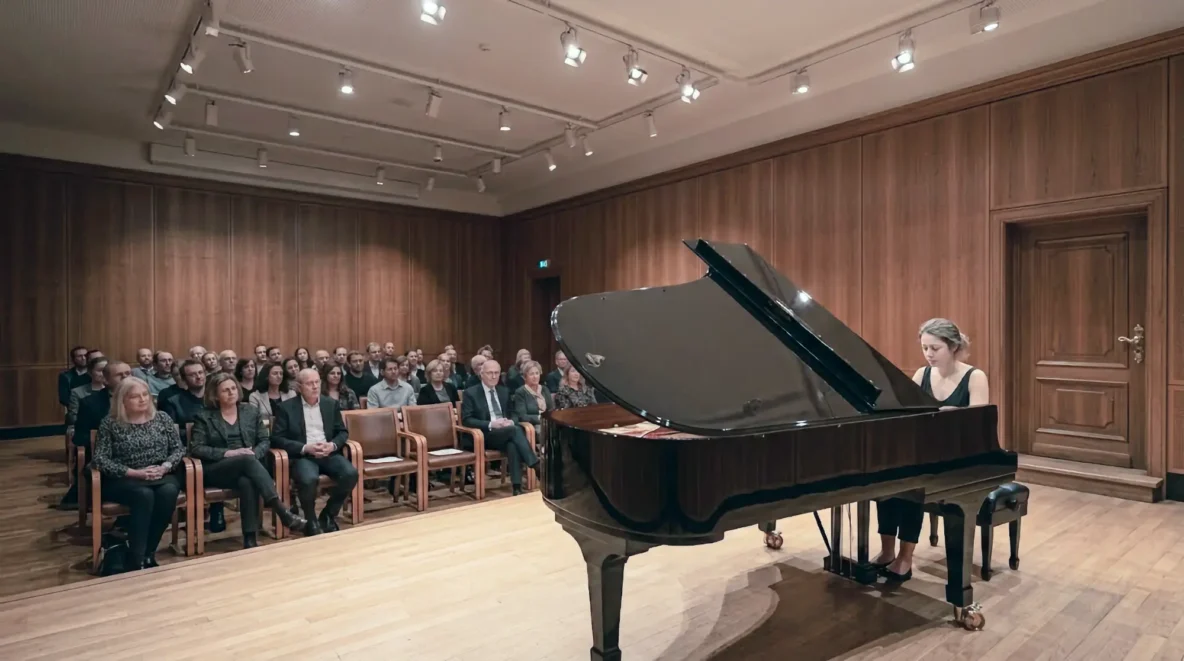
Why Do I Perform Worse on Stage Than I Do in Practice?
Last updated: August 2026
Key takeaways
- Performing worse on stage isn’t evidence that your practice was fake or that your ability is smaller than you thought.
- Stage Fright (aka performance anxiety) doesn’t prevent confidence. It undermines the confidence you already possess.
- Performing well takes attention, and anxiety spends that attention twice: once on the body’s alarm response, and again on your effort to fight it.
- The practice room is missing the three conditions that produce Stage Fright, which is why the problem typically appears only when someone is watching.
- The goal isn’t zero nerves. It’s a workable performance, and that’s what the READ method is built for.
Why do I perform worse on stage than I do in practice?
Because your ability didn’t shrink when you walked on stage. Stage Fright arrived and started spending the attention you need for performing. It’s blunting your edge and keeping you from fully deploying the artistry you already own.
You aren’t suddenly less skilled under the lights. The conditions changed, and your Internal Bodyguard responded.
Why this happens
That familiar feeling rushes in: tightness in your chest, a tremble in your hands, a pounding heart. The room may blur and your thoughts start to spiral.
It rattles you because you prepared so hard for this moment. You thought you’d be confident. Instead, self-doubt starts hounding you and you wonder whether something is wrong with you.
There isn’t. What you’re experiencing is Stage Fright, and it’s real, physical, and deeply misunderstood.
You’re also in good company. When van Kemenade and colleagues surveyed professional symphony orchestra musicians, 59% reported performance anxiety serious enough to affect their professional or personal lives. In the Australian Actors’ Wellbeing Study, 28% of the women surveyed reported debilitating performance anxiety. Among professional ballet dancers, 65% reported experiencing it frequently. A systematic review of performance anxiety in professional musicians found prevalence estimates ranging from 16.5% to 60% across 43 studies.
Here’s the part almost everybody gets backwards. Most performers assume that if they could just find more confidence, the nerves would go away. It’s often the opposite. Stage Fright can undermine confidence you already possess.
For a lot of you, I don’t need to teach you how to be more confident. You’ve already earned it. You’re the musician who has mastered the score, the actor who owns the role, or the dancer who has embodied the choreography. That artistic mastery is the taproot of your confidence.
The problem isn’t a lack of confidence. Stage Fright is blunting your edge.
Your Internal Bodyguard is doing its job
The surge you feel isn’t a malfunction. It’s your brain trying to protect you.
A small almond-shaped structure called the amygdala acts as an Internal Bodyguard. It can interpret performing in front of others as danger and set off the body’s stress response, flooding you with adrenaline and preparing you to fight, flee, or freeze. It can also leave your mind going blank.
The Stage Fright page walks through that mechanism in full. If the version of this you feel most strongly is physical, see why you shake on stage and not when you practice.
The practice room is missing three ingredients
There’s a logical formula behind Stage Fright:
Audience + Judgment + Threat = Stage Fright
You need an audience, a sense that you’re being judged, and the feeling that the judgment could cost you something. The Stage Fright page unpacks all three factors.
What matters here is that those conditions usually aren’t present when you practice alone. That’s the difference. What happens on stage is a predictable response to specific conditions, not a personal failure.
It’s also why the same drop can hit you in a rehearsal, audition, casting call, masterclass, or lesson. It doesn’t require a concert hall. It requires an audience whose judgment feels like a threat.
Fighting the nerves costs you the attention you need for performing
We like to believe we have substantial control over our thinking, but we have far less than we suppose. That creates a trap. We assume that if we could just banish the negative thoughts, we’d find calm.
That approach often backfires. You end up playing Thought Whack-A-Mole.
Try sitting with a completely still mind for one minute. No random thoughts. Most people can’t do it, and that includes me.
Now notice the conditions of that experiment. You’re sitting quietly, deliberately trying to stay clear, with nothing at stake. What chance do you have when nervous thoughts are pestering you in the middle of a performance?
Not much, and fighting them costs you the attention you need for performing. Your ability is intact. Your attention is being spent wrestling with your Internal Bodyguard instead of being directed toward your artistry.
How to work with it: the READ method
You don’t need to win an argument with your thoughts. You need a simpler approach you can call on while performing. That’s the READ method, the framework at the heart of Perform with Confidence.
Remember the core values that give you the courage and commitment to stand up to your anxiety.
Engage fully in performing.
Accept anxious thoughts or feelings each time they disrupt your concentration, rather than fighting them, and return your attention to performing.
Detachment from your anxiety follows, allowing you to enjoy a more workable situation.
Engagement means being absorbed in the task at hand. By immersing yourself in performing, you stop spending so much attention on your nerves and direct more of it toward your artistry.
Acceptance can feel abstract because it’s passive. It means choosing not to resist the nervous feeling. Think of it like a cloud passing in the sky. You notice it without pushing it away or holding on to it, then return your attention to performing.
It’s also like one of those childhood finger traps. Pull against it and the grip tightens. Stop pulling and it loosens.
Detachment isn’t something you force. It’s the fruit of your efforts. As you engage with the performance and stop fighting the nerves, their grip can begin to loosen.
What should I actually be aiming for?
Not a flawless performance. A workable one.
I’m not offering a one-and-done cure for Stage Fright because there isn’t one. It can return whenever the formula of audience + judgment + threat is present. Saying, “I will never get nervous again,” is a dead man’s goal, the kind only a dead person could achieve.
The better question isn’t “How do I eliminate my nerves?” It’s “How unworkable does anxiety make performance situations for me, and in what specific ways?”
That question you can answer, and answering it gives you somewhere to go.
Why practicing at home isn’t enough on its own
Practicing mindfulness under ideal conditions is a great start. But as Zen Master Seung Sahn would say, that’s like sitting behind the wheel of a car parked in a garage. At some point you need to take it onto the streets.
The same is true of performing. Distractions are part of the deal. The skill you need isn’t performing perfectly in an empty room. It’s returning your attention to your performance, over and over, while something is pulling it away.
Every return is a rep. That’s how you build a more workable response to the nerves that have been undermining you.
One small change of word
Instead of telling yourself, “I want to do well, but I’m nervous,” try, “I want to do well, and I’m nervous.”
One word, big difference. Success and anxiety can coexist, and they often do.
Frequently asked questions
Why do I play worse in performance than in practice?
For the same reason an actor goes up on a line or a dancer stiffens in the wings. Stage Fright spends attention your performance needs, so your ability is still there but less of it may be available in the moment. The mechanism doesn’t care which art form you practice.
Does this mean my practice was wasted?
No. Your practice built real ability, and that ability is still there on stage. Stage Fright doesn’t remove what you’ve earned. It can blunt your edge and keep you from fully deploying your artistry.
Will I ever stop getting nervous before performing?
Probably not entirely, and that’s not the target. Stage Fright can arise any time you perform for others whose judgment feels like a threat. Aim instead for a more workable performance.
Is it normal for my mind to go blank on stage?
Yes. When your Internal Bodyguard reacts to the performance as a threat, the stress response can disrupt your attention and make familiar material temporarily harder to access. It’s a natural response, not a character flaw.
Should I just try to calm down and think positive?
Trying to force anxious thoughts away often creates more struggle. Accepting the nervous thought and returning your attention to the performance is more consistent with the READ approach than arguing with what your mind is producing.
Why does this happen in rehearsals and auditions too?
Because the formula doesn’t require a concert hall. Audience + Judgment + Threat is enough. Stage Fright can appear in rehearsals, auditions, casting calls, masterclasses, competitions, and other situations where you perform in front of others and the stakes feel high.
Where to go from here
If your Stage Fright shows up mainly as shaking or tremors, see Why Do I Shake on Stage and Not When I Practice?
If you sometimes lock up completely, see Why Do I Freeze on Stage?
If memory is the main problem, see Why Do I Forget What I Practiced?
The READ Method: Four Steps to Tame Stage Fright explains the framework at the heart of Perform with Confidence.
If you’d rather experience the approach firsthand, the free intro lesson for Perform with Confidence gives you a practical introduction at no cost and with no card required.
Dr. David Lee Fish, Ph.D. is a performance anxiety specialist and the founder of Rise Up Eight. He is a direct student of Korean Zen Master Seung Sahn, the same Korean master who taught Jon Kabat-Zinn, and the author of The 5-Day Stage Fright Solution.