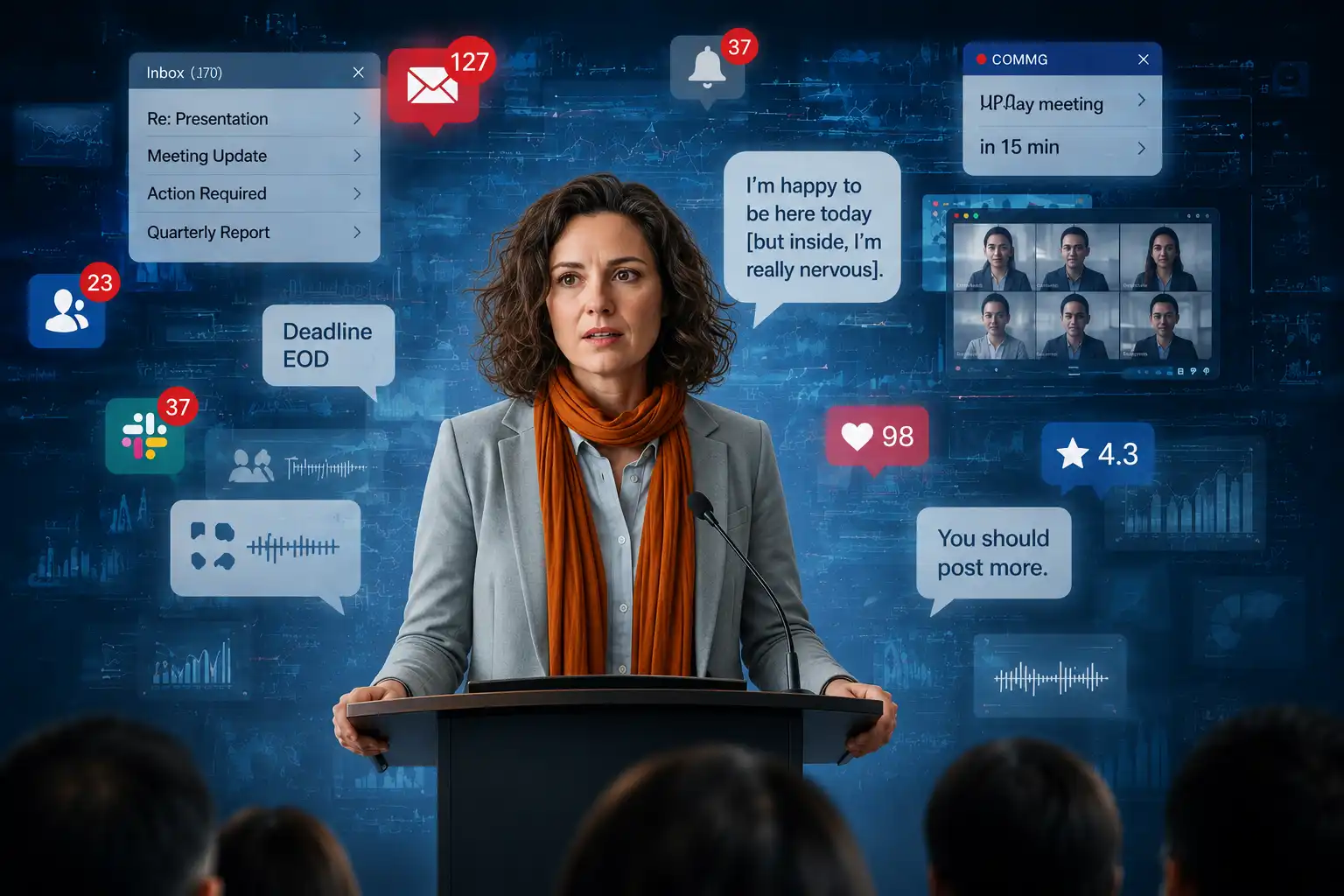
Quick Answer: Performance anxiety in the digital age is rising because social media has turned everyday professional life into a series of high-visibility moments, training your brain’s internal bodyguard of performance anxiety to step into protect you more often. The solution is not silencing the bodyguard but learning to mindfully accept it and return attention to the task.
What Is Driving the Rise in Performance Anxiety in the Digital Age?
A recent feature in The Atlantic traced rising propranolol prescriptions to something less visible: the performance demands of everyday digital life. Social media has not just given professionals a stage. It has multiplied stages across every working week. A speaker who once faced performance pressure only in boardrooms now faces it making LinkedIn posts, recording video messages, and presenting in virtual meetings with cameras on.
Your brain’s internal bodyguard, the amygdala, cannot tell the difference between a live presentation and a public video. It responds to the same predictable formula: audience, judgment, and stakes. When that formula fires daily rather than occasionally, the bodyguard grows increasingly trigger-happy.
Research on the developmental roots of performance anxiety adds another layer. A 2026 study in Frontiers in Psychology traces how early experiences of perfectionism and fear of judgment train the internal bodyguard to activate in response to evaluation. This is a learned pattern, not a fixed trait. That distinction matters, because what is learned can be worked with.
The temptation is to treat rising performance anxiety as a confidence problem. It is not. You already have the confidence. Every professional who survived a tough audit, closed a hard negotiation, or delivered a difficult performance earned it. What performance anxiety does is interrupt that confidence, the way an alarm drowns out a conversation.
The standard response, fighting the nerves and trying to suppress or push through them, works like a Chinese finger trap. The harder you push, the tighter the grip. The Rise Up Eight approach teaches the opposite: accept the signal without obeying it, redirect attention to the task, and let detachment follow naturally. That is the READ method.
What Is the READ Method for Performance Anxiety?
READ stands for Remember, Engage, Accept, Detach.
Remember your core values: the reason this moment matters to you. That grounding supplies the courage to stay present even when the bodyguard is signaling danger.
Engage fully with the task: the words you are saying, the person you are addressing, the work in your hands. Attention placed “on the task at hand” removes it from the alarm.
Accept the anxious thoughts and physical sensations without judgment. They are not commands. They are like clouds passing through. You do not have to make them stop before continuing.
Detach. This is not an action. It is the natural result of engaging and accepting. The grip loosens on its own.
The goal is workability, not silence. How present and effective can you be in a high-stakes moment, even when the internal bodyguard is active? That is the real question, and READ answers it.
Does Performance Experience in the Digital Age Build Real Resilience?
New research on Japanese musicians (Frontiers in Psychology, 2026) found that accumulated performance experience reduced music performance anxiety more consistently than time spent at a specialized music school. The internal bodyguard calibrates to what is actually dangerous, and repeated real-world exposure teaches it that the stage is not a threat.
This is what the READ method accelerates. Rather than waiting for decades of stage time to build resilience naturally, READ gives you a framework to stay present and functional in each performance, building the track record your nervous system needs to recalibrate faster.
What Do Professional Performers Actually Do?
A study of six professional classical musicians (MDPI Behavioral Sciences, June 2026) found that those who performed without debilitating anxiety relied on cognitive and schematic strategies. They directed attention deliberately rather than following the alarm. They had learned where to place focus, not how to eliminate fear.
That is not a talent. It is a trainable skill, and it is exactly what a method-based approach teaches.
Frequently Asked Questions
Is performance anxiety in the digital age different from traditional stage fright?
Yes. Traditional stage fright was triggered by formal performance settings. Performance anxiety in the digital age fires across a far wider range: video calls, social media posts, online presentations, and recorded meetings. According to the American Psychological Association, performance anxiety affects people across many contexts, and digital demands have expanded its reach significantly. The internal bodyguard responds to the same formula regardless of the setting.
Is social media making performance anxiety worse?
Research suggests yes. When professionals face daily pressure to be visible online, the brain’s internal bodyguard responds to each post, video, and meeting as a potential high-stakes moment. The result is a more easily triggered anxiety response across all performance settings, not just formal presentations. You are not alone in experiencing this.
Does medication help with performance anxiety?
Some medications may reduce physical symptoms temporarily, but they do not address the cognitive patterns driving the response. A skill-based method teaches attention control and acceptance that transfer to every performance context, building a capacity that does not depend on medication to sustain.
Can performance anxiety be cured?
No, and aiming for a cure tends to make anxiety worse by creating one more thing to fight against. The Rise Up Eight approach targets workability: how present and effective can you be in a high-stakes moment, even with nerves present? Progress, not silence, is the goal.
How quickly does the READ method produce results?
Most students notice a shift in how they relate to nerves within the first lesson. The method does not promise to eliminate anxiety before a performance. It gives you a clear process for engaging and accepting the nerves so that anxiety no longer controls the outcome.
Take the First Step
If performance anxiety is showing up in more places than it used to, you are not alone. The rise in performance demands across professional and creative life is real, and waiting for confidence to return on its own is not a strategy.
Tame your performance anxiety with a proven method, now available. The Speak with Confidence course is built on the same READ framework described here. The free intro lesson costs nothing, takes less than an hour, and gives you the first step directly.
Speakers, performers, athletes: start here. riseupeight.com/swc/free-intro