

Why Do I Get Nervous Before Speaking?
You can get nervous before speaking because anticipating an audience and its judgment is enough to make the situation feel threatening. Speech Fright doesn’t have to wait until you say your first word. You can begin working with it beforehand by recalling what matters to you, doing the preparation the situation needs, and practicing how you respond when worry interrupts.
Key takeaways
- Speech Fright can begin days before a presentation or while you’re waiting for your turn in a meeting.
- Feeling anxious beforehand doesn’t tell you exactly how the speaking situation will go.
- Remember matters before you speak. Your values can give you a reason to prepare and participate despite the discomfort.
- Useful preparation has a task you can complete. Repeatedly imagining what could go wrong can keep you occupied without preparing you.
- The target is a workable speaking situation. Feeling completely calm doesn’t have to become an entrance requirement.
Why do the nerves start before the audience is there?
An upcoming presentation can occupy your attention long before anyone takes a seat. You imagine forgetting your opening, being challenged by a colleague, or looking nervous. The event is in the future, but your reaction to thinking about it is happening now.
In Speak with Confidence, we describe this protective response as your Internal Bodyguard. It reacts to what seems threatening, including the prospect of being judged. The familiar pattern is Audience + Judgment + Threat = Speech Fright. Anticipating those conditions can be enough to start worrying.
This helps explain why a calendar reminder or the words “You’re up next” can change how you feel. You may have been working comfortably a moment earlier. Now your attention has moved from what you know to what might happen when others hear you.
Do strong nerves mean I’m going to speak badly?
They don’t give you a reliable preview of the entire event. You may be imagining a difficult moment and treating the intensity of that image as evidence that it will happen. “I feel this anxious” and “I won’t be able to speak” are different statements.
The nervousness still deserves a practical response. It might be pulling you away from preparation or making it difficult to listen while others speak. Those are things you can work on without first deciding that you must feel confident about every possible outcome.
What should I do in the days before a presentation?
Start with the reason the speaking situation matters. Ask, “What matters to me in this situation, and what do I want to stand for?” Perhaps you value sharing knowledge, helping your colleagues make a sound decision, or honoring someone important to you.
A value is a direction, like a point on a compass; a goal is a destination. Honesty is a value. Speaking honestly is a goal derived from it. Your value can guide how you prepare today, even though the presentation and its outcome are still ahead of you.
Then choose the next piece of preparation you can actually finish. You might check an important figure, clarify your main recommendation, or explain your opening point aloud. When you catch yourself replaying an imagined disaster, accept that the thought has appeared and return to the preparation in front of you.
This isn’t a demand to prepare constantly. Once a task is done, move on to the next part of your day. Worry can return without requiring you to reopen your slides every time it does.
How do I calm down while I’m waiting to speak?
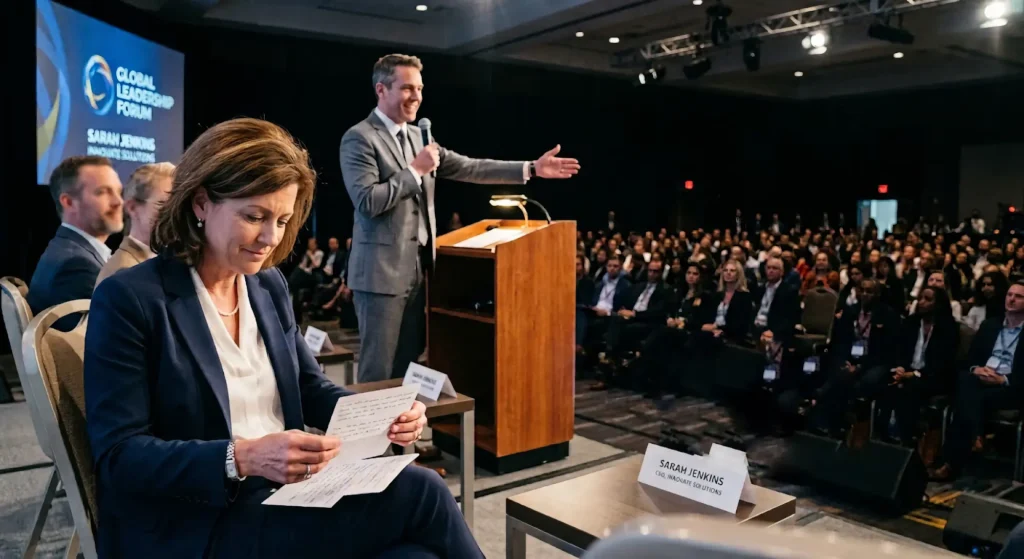
It’s understandable to want relief, but making calmness the test of readiness can create another problem. You check your heartbeat, notice it’s still fast, and conclude that you aren’t ready. Then you check again, while the meeting or event continues around you.
Try using the waiting time to practice attention. In the course’s Mindful Waiting exercise, you notice the impulse to rush or escape the moment, bring your attention to the sensation of breathing, and accept distractions before returning. You’re practicing the return, rather than making your breathing pass a test.
If someone else is speaking and you need to follow the discussion, listen. When worry takes you into an imagined version of your own turn, accept the interruption and return to what the person is saying. Keeping up with the conversation is more useful than rehearsing answers to questions nobody has asked.
How does READ apply before I begin?
The full READ method is there for the speaking situation. Remember can start beforehand, when you need courage to prepare, show up, or stay involved rather than withdraw.
Remember the core values that give you the courage and commitment to stand up to your anxiety.
Engage fully in speaking.
Accept anxious thoughts or feelings each time they disrupt your concentration, rather than fighting them, and return your attention to speaking.
Detachment from your anxiety follows, allowing you to enjoy a more workable situation.
Imagine you’re about to explain a service problem to a client. You value being dependable, and you want the client to understand what happened and what you can do next. That gives you a reason to participate even though the conversation may be uncomfortable.
While waiting, you recall that value and return to the task in front of you. When the conversation begins, you engage in explaining the situation. If “They’re going to be angry” interrupts, accept the thought and return to the information the client needs. Detachment follows from applying Remember, Engage, and Accept; it isn’t something you must achieve in the waiting room.
The full READ method explanation shows how values support the other steps. You don’t need to rehearse the acronym continuously while you wait.
Why do I want to avoid or cancel the speaking situation?
When speaking feels threatening, backing out offers the prospect of relief. You might delay preparing, hope somebody else will take over, or start looking for a reason not to attend. That urge can arise even when you care about the opportunity.
Before deciding, return to your values and the actual circumstances. Is there a practical reason to change the plan, or are you mainly trying to avoid feeling nervous? Those possibilities call for different responses. Commitment to speaking doesn’t mean ignoring illness, unreasonable demands, or a genuine change in priorities.
If anxiety is driving the decision, choose a manageable action that keeps you involved. Finish one part of your preparation, confirm the arrangements, or plan the contribution you intend to make. Let what matters guide that action rather than waiting for the urge to avoid it to disappear.
Frequently asked questions
Why does my heart race before I speak?
Anxiety can produce a faster or more noticeable heartbeat. The NHS includes heartbeat changes and nausea among possible anxiety symptoms. Their presence before speaking doesn’t, by itself, tell you how well you’ll communicate. Don’t assume new or concerning physical symptoms are only nerves; seek medical advice when needed.
Why do I feel sick before a presentation?
Nausea can accompany anxiety, so the discomfort may arrive while you anticipate the presentation. Repeatedly checking whether it has gone away can also keep your attention on how you feel. Work with the anxious thoughts while attending to your practical needs, and get medical advice if the symptoms concern you or persist.
Can I feel nervous for several days before a short speech?
Yes. The amount of time you spend anticipating an event can be much longer than the event itself. Break preparation into specific tasks, recall why speaking matters to you, and practice returning to ordinary activities when worry interrupts them.
Should I use breathing to make all the nerves stop?
You can use attention to breathing as mindfulness practice, but the exercise doesn’t have to end with all anxiety gone. Notice the sensation, accept distractions, and return. Once you’re speaking, your task is to communicate rather than keep checking your breathing.
What if I’m still nervous when it’s time to start?
Recall what matters and begin with the point you prepared. You can want to do well and feel nervous at the same time. “Never get nervous again” is a dead man’s goal; a more workable goal is to begin and keep returning to speaking when anxiety interrupts.
Where to go from here
For the broader explanation, read Speech Fright: Why It Happens and How to Tame It. It explains why nervousness can undermine confidence you already possess, including before you begin speaking.
To start practicing the approach, start with the free Speak with Confidence introductory lesson. It introduces the method and a simple mindfulness exercise you can use before your next speaking situation.

Dr. David Lee Fish, Ph.D., is a performance anxiety expert and the creator of Speak with Confidence—an online course that helps professionals tame speech fright—and a growing curriculum that extends his method to performers and competitors.
His approach has an unusual origin: while studying Zen under Korean master Seung Sahn at the Empty Gate Zen Center, Dr. Fish learned a technique that would also shape the mindfulness movement. (Seung Sahn also taught Jon Kabat-Zinn, founder of Mindfulness-Based Stress Reduction.) Dr. Fish’s approach to performance anxiety grew from that Zen training, independently of but in parallel with mindfulness.